Saturday, October 5, 2024

Why The Islamic Republic in Iran is Islamic

Mohamed Ousman

When we speak about an Islamic State, we are speaking about extending Divine power and authority into human affairs. All Muslims profess: “There is no power and authority worthy of conformity to except Allah, and Muhammad is His Messenger.” So let us begin by explaining power in the Islamic paradigm.

Firstly, it is important to acknowledge that power is the sole possession of Allah:

“Say, ‘O Allah, Lord of all dominion! You grant sovereignty to whom You will, and You take away sovereignty from whom You will...’” (The Ascendant Qur’anSurah Aal Imran, verse 72)

When Allah entrusts power to His servants and subjects, He is testing people to see whether they will do what He wants, when He wants and how He wants it done.

In the context of our transient life, Islamic power, practically, is the ability to implement holistic systems and programs to proactively socialize Allah’s Will; eradicate satanic pulses that obstruct the ability to frame public policy to Allah’s satisfaction and the benefit of humanity; encourage and, if necessary, even enforce public behavior accordingly.

An example will clear this up. If there is widespread impovertization (not poverty, which is a symptom) then power is needed to enact laws and policy—not to cut the hands of people who struggle to survive—to equitably redistribute resources. This power to redistribute resources ensures that people don’t live at the survival level. Thereafter comes deterrent laws to prevent theft and then enforce those laws if need be.

This means that the most effective expression of power is at the state level when it is exercised according to scripture and hence it becomes an expression of Allah’s Will. Power in the Islamic context can never be exercised in exclusion of Allah’s Will.

The next level of power expression is the Islamic Movement which is the conscience of the Islamic State. It comprises those selfless souls who will always keep in check abuses by the state, Islamic as it may be.

Together, these are the two complementary forces that form the backbone of the Islamic State, viz. Divine Will in the hands of powerful Divine subjects.

Once we understand this to be the backbone of the Islamic model of state, the next step requires that we know about walayat al faqih, not wilayat al faqihWilayah (with a kasrah on the و ) refers to something physical but walayah (with a fat’hah on the و) refers to something conceptual, intangible, beyond borders, etc.

Once we make this conceptual leap, we are ready to collapse 1400 years of schism and develop a common understanding of what our responsibilities to the Islamic state are.

The Islamic Republic in Iran stands for everything the model Islamic State in Madinah at its inception stood for:

1: Independence from the forces of kufr and shirk;

2: Reliance upon Allah; and

3: Non-reliance upon the KafirinMushrikin and Dhalimin (those in rejection of Allah’s Power and Authority, those who rival His Power and Authority and those who oppress, respectively).

These three cornerstones come out of the unmistakable words of Allah.

The leaders of kufrshirk and dhulm desire that Muslims negotiate away their worldview so that they may do the same. This Divine cautionary was taken up by the revolutionary leadership in the Islamic Republic in Iran where, as numerically few in the world, it refused to negotiate away its Islamic self-determination and opposition to global oppression.

It pays a huge price for this uncompromising principled position, reminiscent of the Prophetic words, “by Allah, O my uncle, if they put the sun in my right hand and the moon in my left hand on condition that I leave this affair of relocating power and authority to its Divine source; I will never abandon it until I am either successful or I perish in the process.”

This was the response of Allah’s Prophet when Quraysh tried to use his uncle, Abu Talib, to tempt him with four proposals including having leadership of Arabia.

How many offers have the leaders from the worldview of kufrshirk and dhulm brought to the leadership of the Islamic Republic in Iran over the past 45 years? Yet, the revolutionary leadership has not compromised on the three afore-mentioned fundamentals.

When the Imam was mapping an independent Islamic course and policy for the Islamic Republic in Iran, an advisor told him, “The KafirinMushrikin and Dhalimin in the west will impose crippling sanctions on the Islamic Republic in Iran, isolate it and cause the Muslims there to suffer, etc.” The Imam concluded by saying “our objective is not to sacrifice Islam to save our economy or country. Rather our economy, country and everything is expendable for Islam.”

This revolutionary leadership understood and continues to understand that the KafirinMushrikin and Dhalimin will not come and say “here’s your Islamic State on a golden platter.” Neither should Muslims rely on them to construct Islam in real life. Muslims have to work for it and people who think in terms of profit and loss will not be cut out for that task.

The detractors of the Islamic Republic in Iran say, it is part of the structures of kufrshirk and dhulm such as the United Nations and other forums. We take them back to the Prophet (pbuh) who was independent in his worldview yet he used and exhausted the protection within the tribal setup of Arabia until it could not be used any more.

The subtlety that these hasty detractors miss is that the Prophet (pbuh) was using the tribal system without being integrated into it, without being used by it, without relying on it and without being beholden to it. No one was dictating to the Prophet how he should operate in trying to construct his alternative Islamic model while rejecting the jahili status quo.

Another interfering issue blocking people’s ability to identify the Islamic Republic in Iran as Islamic is their misunderstanding that it is fractured and not part of the global Muslim Ummah and thus has a lot to do internally before looking externally. While it is true that not everyone in the Islamic Republic in Iran serves the Islamic course 100 per cent, that situation existed in Madinah too when not everyone served the Prophet’s Islamic State with sincerity.

Actually, these detractors who cannot see this historical development project their nationalistic thoughts and thus fail to realize that if some Muslims in the Islamic Republic in Iran fail to overcome nationalism and localization, it does not detract from the fact that the state is Islamic.

One only needs to review the policies of the Islamic Republic in Iran and its revolutionary leadership rather than the actions of individuals who may be showing signs of weakness, Persian nationalism or Shi‘i sectarianism, nowadays.

Let us appreciate that the extension of the foreign policy of the Islamic Republic is Iran is trans-national as it operates in Lebanon, Palestine, and other areas. That outreach projects by the Islamic Republic in Iran, although consistent in the past, are in need of improvement.

But what has been the response of Muslims outside the Islamic Republic in Iran? Have they been up to par with their supportive Islamic duty?

A third underlying problem with un-thinking Muslims is their lack of understanding of how the Islamic State develops. Unfortunately, the Muslim mind is undeveloped in Islamic political thought so people say “but the Islamic State in Iran has this or that which contravenes the Shari‘ah”. Allah revealed the Qur’an over 23 years and not in one lump-sum and not in a vacuum.

One cannot expect a nascent state to be operating as a full-fledged one. The Madinah of the Prophet was not a full-fledged Islamic State at inception. The ayaat outlawing riba eventually were among the last to descend. The reason being that society goes through a journey of incrementally maturing which ushers in these eventualities. So, although at inception the Islamic State in Madinah had riba, the direction of the state and society was heading away from kufrshirk and economic dhulm.

The pertinent question that these doubting Thomases should ask themselves is where are they in regards to the bay‘ah i.e. their pledge of allegiance and the ta‘ah i.e. their pledge of obedience to the Islamic leadership when they make their demands and expectations!?

Notwithstanding their vacillation, the influence of the Islamic Republic in Iran is growing despite the vehement protestations by internal and external Munafiqin. Whether the Muslims can’t or don’t want to see the influence of the Islamic State, certainly the zionists and imperialists know it and are trying to eradicate it by all means of intrigue and subterfuge.

Let us remind these delinquent detractors that the concept of the bay‘ah and the ta‘ah is Qur’anic. Had it not been for their failure to break out of their own nationalism, localization and sectarianism and respond, as ordered by Allah and His Prophet, to the outreach projects of the Islamic Republic in Iran, it could have avoided many of the apparent compromises that they criticize.

As an Ummah we cannot have multiple trajectories. Nationalism and sectarianism are violations of the single Ummah concept and the detraction is fundamentally wrong and problematic. Allah says: “Indeed, this is your Ummah [when it is] one Ummah—and as I am your Sustainer, you should conform to Me.” (The Ascendant Qur’anSurah Al Anbiya’ verse 92).

The above being said, the Islamic Republic in Iran is not perfect. It has problems and some problematic officials, but the revolutionary leadership remains sincere. The Prophet (pbuh) says all the descendants of Adam are error prone…

Muslims should differentiate between those who are automatically and deliberately making mistakes from those who are making ijtihadi lapses and operational miscalculations from lack of experience. And where there are problems in need of fixing, it is the responsibility of the global Islamic Movement to advise and if warranted pressurize the leadership, with their helping hands, to attend to and fix the problems.

For the Prophet goes on, ... “and the best of these error-prone descendants of Adam are the ones who make amends.” The leaders of the Islamic Republic in Iran cannot ignore its well-wishers nor insist on errors and sins. That would constitute the first step towards degeneration and there would be no difference between the detractors who ignore the Islamic State, and the Islamic State that ignores the Islamic movement.

Islamic Republic of Iran

Tajikistan Submits Iranian director’s “Melody” for 2025 Oscars

TEHRAN- Tajikistan has officially submitted the film "Melody," directed by Iranian filmmaker Behrouz Sebt Rasoul, for consideration in the Best International Feature Film category at the 2025 Oscars. This submission represents Tajikistan's first entry in 19 years and stands as its third submission overall.

In a talk with the Tehran Times on Saturday, the director confirmed that the submission was made by the Union of Cinematographers of Tajikistan.

The Union of Cinematographers of Tajikistan is an organization appointed by AMPAS to select the Tajikistan's submission for consideration for the International Feature Film Award (formerly known as the Foreign Language Film Award) at the Oscars.

“Melody” tells the story of a young musician girl, Melody, who is determined to compose a heartfelt piece for children battling cancer, using the recorded sounds of thirty different birds, despite the presence of hunters in the area. She returns to her home village in order to capture the beautiful sounds of the birds and receives assistance from the speechless caretaker of her family's house, Mango. 

After discovering a mere twenty birds, Mango reveals to her that the location of the remaining birds is known only to the wise village singer, who has been driven away from the village by the bird hunters. Melody embarks on a journey to locate both him and the missing birds.

Set in a stunning natural backdrop, the story unfolds amidst the enchanting beauty of the surroundings. Screenwriter Sebt Rasoul skillfully incorporates elements like birds, children, music, and nature itself to elevate the narrative, transforming the film into a mesmerizing experience.

Sebt Rasoul's third feature film combines the captivating elements of social genre with a touch of mysticism. 

The film stars Iranian actor Diman Zandi, Alireza Ostadi and Meghdad Eslami from Iran as well as  Safar Haqdodov and Zulfiya Sadikova from Tajikistan. 

"Melody" premiered internationally at the International Film Festival of India (IFFI) in Goa on November 24, 2023. The film is produced by Sebt Rasoul’s Tehran-based Nama Film Company in collaboration with the state-owned Tajikistan broadcaster Safina.

Dreamlab Films, the France-based international distributor under Iranian film expert Nasrin Mirshab, is handling the international sales and distribution of “Melody”.

The film has garnered significant recognition on the international stage, participating in several prestigious film festivals. It was showcased in the 21st Chennai International Film Festival in India in 2023. Following this, "Melody" was selected for the competitive section of the 42nd Fajr International Film Festival in Iran in February, and the 24th Keswick Film Festival in London in March. 

At the 23rd ImagineIndia Film Festival in Madrid, Spain, the film achieved remarkable success, winning several awards including Best Director of Photography, Best Music Design, and Best Original Music. Additionally, it received a nomination for Best Actress and Best Sound Design at the same festival. 

"Melody" continues to attract attention, with its inclusion in the Iranian Film Festival Zurich and the 11th Silk Road International Film Festival in China in September. The film will also participate in the competitive section of the 4th Izmir International Film Festival in Turkey in November, as well as the 11th Duhok International Film Festival in Iraq in December. It is also set to go on screen at the panorama section at the Australian Cinémathèque in Brisbane, Australia, in February 2025.

The film was chosen as Tajikistan's entry for the Best International Feature Film at the 96th Academy Awards; however, it did not make the final list due to a late submission. In contrast, the film was submitted on time for the 97th Academy Awards.

Tajikistan's last Oscars’ submission occurred in 2005 with the romantic drama "Sex & Philosophy," directed by Mohsen Makhmalbaf. However, that submission was disqualified due to the late arrival of the film's print to the Academy. The only other instance of Tajikistan entering a film in the Oscars was in 1999, with Bakhtyar Khudojnazarov's comedy-drama "Luna Papa," which did not receive a nomination.

With the timely submission of "Melody" for the upcoming 97th Academy Awards, Tajikistan has reignited hopes for recognition on the international stage, highlighting the artistic collaboration between Iranian and Tajik filmmakers.

Friday, October 4, 2024

UN resolution and the movement to liberate Palestine

On September 18, a world that has stumbled to find its voice through eleven months of genocide in Palestine, finally spoke. The General Assembly of the United Nations, a body unconstrained by the U.S. veto, and in which all countries have a seat, overwhelmingly endorsed the findings of the International Court of Justice (ICJ), and declared that the occupation of East Jerusalem (Al-Quds), the West Bank, and Gaza is unlawful and must end entirely, that every soldier and settler must be removed, that the apartheid wall must be dismantled, relevant laws repealed, that Palestinians must be compensated and allowed to return home, and that Israeli-imposed racial segregation and apartheid in Palestine must cease. And it declared that Israel must immediately comply with the provisional measures of the ICJ issued by the court in the genocide case brought against Israel by South Africa.

By Craig Mokhiber

An American former UN human rights official

Despite intense U.S. and other Western efforts to derail the resolution, the vote was not even close. 124 countries voted in favor (two-thirds of the world), while only 14 voted against, including the United States, Israel, and a few right-wing regimes and pacific dependencies of the United States. The votes in favor included Western countries like Spain, Belgium, Ireland, and Iceland, as well as U.S. ally Japan, P5 powers China and Russia, and almost the entire global South. Several European states abstained.
When the votes were counted, there was a sense that the UN had, at least for a moment, regained its soul. Conscious of the historic nature of the moment, the Assembly broke into applause. As the gavel came down, delegations celebrated in the aisles and lined up to shake the hand of the Palestinian ambassador.
And historic it was. After a three-decade detour during which U.S. pressure and the Oslo smokescreen diverted the world’s attention while Israel’s repression and dispossession of the indigenous Palestinian people were expedited, the resolution returned the UN to its mandated focus on freedom, on human rights, on equality and on the protections of international law for Palestine.
As such, the resolution vindicated the appeals of the long-suffering Palestinian people, a global movement demanding a free Palestine, and international law itself.
And the Assembly did not stop there. In a historic repositioning of the global community, the resolution (following the lead of the ICJ) rejected the unjust (and failed) paradigm by which Palestinians were expected to negotiate for their rights with their oppressor. In its place, the resolution has (re)established a framework of decolonization underpinned by international law. The Palestinian people’s right to self-determination is, according to the resolution, an inalienable right, and is not subject to conditions imposed by Israel. And Israel’s “security concerns” do not override Palestinian rights in the Palestinian territory over which Israel can never exercise sovereignty, the resolution declares. Equally important are the demands placed on all other states by the resolution and by the ICJ findings on which it is based.
The resolution, drawing directly from the ICJ opinion, affirmed that all countries are legally obliged to cease any recognition of or support for the Israeli settler-colonial project in the occupied territory, to work to liberate the Palestinian people and to end Israel’s racial segregation and apartheid, to ban any products from the settlements, to sanction settlers and others involved in Israel’s occupation, and to cut off all military, diplomatic, economic, commercial, financial, investment, trade, political, and legal relations with the Israeli occupation.
In other words, the UN General Assembly has called on all states to participate in a military embargo and in boycott, divestment and sanctions (BDS) to bring the occupation to an end.
Equally historic is the resolution’s endorsement of the court’s findings that the Israeli regime practices apartheid and racial segregation, as prohibited by Article 3 of the UN Convention on the Elimination of Racial Discrimination, marking the (belated) start of the Organization’s alignment with the global movement against apartheid in Palestine (a move urged by UN human rights experts for years). States are called on to work to end these unlawful apartheid systems, and the resolution mandates the UN to prepare a proposal for an international mechanism to combat them.
These provisions in particular will bring important benefits to the global BDS and anti-apartheid movements, and to human rights defenders in civil society more broadly, who have faced significant repression (especially in the West) for their advocacy on these issues. They can now rightly claim that the world, acting through the General Assembly of the United Nations, has not only endorsed their positions but has called on all states to join them.
Predictably, Israel’s defenders are already seeking to deflate the importance of the resolution by saying that it is “non-binding.” Such statements are at best a gross misrepresentation.
First, what the resolution (and the court findings on which it is based) has enumerated is the (pre-existing) legal obligations that bind all states, by virtue of their erga omnes (universally binding) character in international law, and the jus cogens (no exceptions) nature of the Palestinian rights in question. The substance of the resolution is thus binding, even if the UNGA has no power to compel states to respect these obligations.  
Secondly, the resolution was adopted in an Emergency Special Session under “Uniting for Peace”, a UN procedure that gives enhanced powers to the General Assembly when the Security Council fails to act (usually, in this case, due to a U.S. veto). Thus, this is not an ordinary UNGA resolution, and the law that it cites is indeed binding, even if the resolution itself cannot command states to act.
The resolution puts Israel on notice that it must completely end its occupation and apartheid within twelve months or face further consequences. Accountability measures in the meantime are to include the establishment of a mechanism to ensure that Israel pays reparations to the Palestinians, an international register of damage to facilitate that process, evidence-gathering initiatives to that end, and consideration of measures for criminal accountability, including prosecutions for the worst Israeli crimes.
It also calls on Switzerland to convene, within six months, an extraordinary Conference of High Contracting Parties to the Fourth Geneva Convention on measures to enforce the convention in Palestine.
And it decided, as well, to convene an international conference under UN auspices in the coming months to address the implementation of the many UN resolutions on Palestine of which Israel is in breach.
Finally, the resolution mandates a report from the UN Secretary-General in three months’ time on the implementation of the resolution, and decides to keep the matter under UNGA review, so that it does not become dead letter.
Needleless to say, the resolution is not a panacea, and it will not end Israel’s 76-year reign of terror and impunity. It will undoubtedly be ignored by Israel and by its US sponsor, both of which will work behind the scenes to obstruct its implementation. And the resolution itself leaves unaddressed many crucial aspects of the Palestinian struggle, not least the rights of Palestinians inside Green Line Israel and the fate of those purged from their homes there. And, beyond its reiteration of Israel’s obligations under the orders of the ICJ, it does little to end the ongoing genocide.
But seen in conjunction with recent action by UN human rights experts, the International Court of Justice, the International Criminal Court, diplomatic advances in the recognition of Palestine, growing solidarity in global public opinion, movements in civil society across the globe, and steadfast Palestinian resistance, it heralds the birth of a new era: an era in which Israeli impunity is no longer guaranteed, and in which the foundations of Israeli settler-colonialism, apartheid and ethnonationalism have begun to crumble.

The article first appeared on mondoweiss.

Pakistan Sinking Deeper Into The Debt Trap

Waseem Shehzad

Pakistan’s Finance Minister Muhammad Aurangzeb, known to friends and acquaintances as ‘Auri’, is running around like a chicken without a head. Banker by profession, he accepted the thankless job of finance minister in March 2024 in a regime headed by criminals and rapists illegally installed by the military. If ‘Auri’ had any sense—the fact that he would accept the distortion of his name reflects his inferiority complex—he would have declined the offer.

Opportunism and rubbing shoulders with the powers that be, however, is a peculiar trait of the Pakistani elite. For Auri, it was too good an opportunity to pass even if he has a thankless task with no certainty of success. The main reason is that he is not free to apply the fundamental principles of economics. He has to pander to the whims of the morons in uniform.

Pakistan is a bottomless pit. No matter how large the external handouts, they cannot solve its problems. There was much celebration when the International Monetary Fund (IMF) announced in July 2024 that a staff level agreement had been finalized to provide $7 billion in loan.

This is Pakistan’s 25th loan agreement with the IMF and reflects the country’s desperate economic plight. The loan, however, has come with stiff conditions, not all of them in Pakistan’s control.

The IMF demands that Islamabad must first secure rollover assurances from its other creditors, of which there are many. Further, they must also agree to reschedule at least some of the interest payments falling due during the year. Only then, will the IMF agree to release the funds.

Let us identify Pakistan’s creditors. In addition to Saudi Arabia, the UAE and China (to whom collectively it owes $12 billion) there are multilateral institutions like the World Bank, IMF and the Paris Club as well as bondholders. Pakistan owes more to these multilateral institutions than to China, according to Murtaza Syed, a former deputy governor of the State Bank of Pakistan.

Syed now works for the Beijing-based Asian Infrastructure Investment Bank (AIIB). He disagrees with the IMF demand that Pakistan should first get agreement from its other creditors, primarily China, for debt rollover before it would release the funds.

He referred to it as “Fund-speak for securing secret debt relief from China. It is wrong, incomplete, and dangerous,” he warned. “It is wrong because Pakistan’s debt problem is not a Chinese debt trap,” unlike some other countries.

Pakistan is trapped in a Catch-22 situation. The IMF demands that a financing gap be filled first before the programme will release its funds. Creditors insist that a functioning programme must be in place before they will agree to roll-over their debt. They know that Pakistan is ruled by criminals and thieves who will steal wherever their grubby hands can reach.

The creditors may have overlooked even this but for the fact that they know that Pakistan cannot meet its debt obligations. The military-installed regime, with connivance of the army high command, is looking at selling state assets. These include mines, agricultural land, airports and seaports, the country’s airline PIA and a host of other state enterprises.

Given its dire straits, Pakistan’s state enterprises will be sold at throw away prices. Even if a fair market price is secured for these assets, the money coming in will only be a stop gap measure. With its depleted foreign exchange reserves, foreign creditors want assurances that they will be able to repatriate their profits.

At a time when Pakistan is asking creditors to roll-over the interest on money borrowed in the past, what value would its assurances have? Besides, when Pakistani businessmen have no confidence in the economy and are investing their money abroad, foreign investors can hardly be blamed for being cautious.

Even a pro-regime newspaper like the Karachi-based Dawn, was forced to say: “The country’s addiction to foreign loans to pay its bills has forced many to raise critical questions about its financial future and economic sustainability.”

Pakistan’s economic problems stem from lack of political stability. This is the direct result of the military’s overbearing attitude interfering in every aspect of life. Last year, the formation of the Special Investment Facilitation Council (SIFC), was announced with much fanfare. It is headed by an army general.

Soon thereafter, it was announced that $70 billion in foreign investment will flow into Pakistan. This was based on the assumption that since the army is now in charge of economic policy, it will provide security and stability and foreign investors would have greater confidence.

The mad scramble to secure another tranche of IMF loan and to get creditors to rollover their debt indicates that not a penny of the supposed $70 billion has come to Pakistan. It would be foolish for foreign investors to commit such huge sums given the tattered state of Pakistan’s economic fundamentals.

The idea that the SIFC, headed by a general, would assure foreign investors has proved illusory. The army is trained to destroy, not build yet the men in khaki think that they can solve Pakistan’s problems by using more force.

Two of the country’s four provinces—Balochistan and Khyber Pakhtunkhwa—are in turmoil. The military is involved in crushing the people’s genuine aspirations. Instead of allowing a political process to solve these issues through dialogue, the military, more specifically the army is busy fighting its own people.

While it acts as an army of occupation, its chief, General Asim Munir, insists that people must love the army. Can love and respect be earned by holding a gun to someone’s head?

There are thousands of missing persons in Balochistan. The army brands them as “terrorists”. Not one person has been charged, much less convicted in a properly constituted court of law. When the missing persons’ relatives ask for information about their whereabouts or even news of whether they are alive or dead, they are accused of supporting “terrorists”.

Similar allegations are hurled at people in the KPK. No attempt is made to understand their grievances and how to address them, apart from using brute force.

Pakistan is heading in the wrong direction. At the root lies the army’s overbearing attitude and refusal to confine its activities to what is prescribed in the constitution. The one person who has a slim chance of stabilizing Pakistan’s political and economic situation—Imran Khan—languishes in a stinking jail cell.

His “crime” is that he wants to hold to account the crooks and mass murderers who have hijacked Pakistan’s polity. The army and the gang of thieves and rapists won’t allow him to do so. The price is paid not only by Imran Khan but also by millions of poor Pakistanis.

Pakistan

Thursday, October 3, 2024

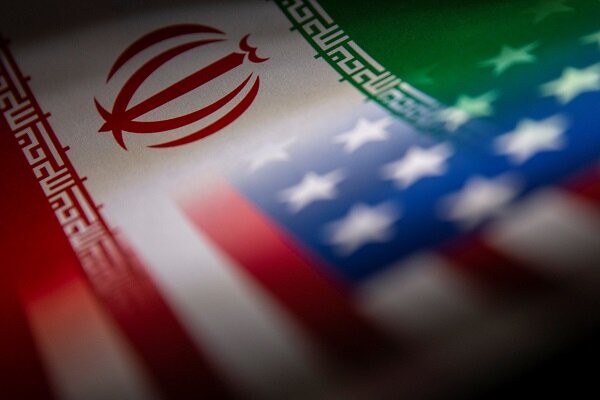
‘Unilateral self-restraint has ended,’ Iran tells US in indirect message

TEHRAN - An Iranian source has told Al Jazeera that Tehran has sent a message to the United States via Qatar addressing the rising regional tensions.

In the message, Tehran told Washington that “the phase of unilateral self-restraint has ended.”

It also said any Israeli attack would meet an “unconventional response” that includes targeting Israeli infrastructure.

The indirect message also emphasized that Iran does not want a regional war, the official said.

In a meeting on Wednesday with a high-ranking delegation from the Palestinian Hamas resistance movement in Dohan, Iranian President Masoud Pezeshkian reiterated Tehran’s position that the Islamic Republic will definitely give a “stronger and more crushing” response to Israel if it commits the “slightest” mistake.

The meeting came a day after the Islamic Republic carried out a retaliatory operation against Israel, dubbed Operation True Promise II.

Pezeshkian criticized Western countries for making empty promises, saying they requested Iran to exercise self-restraint and refrain from giving a response to the Israeli assassination of Ismail Haniyeh, the Hamas political bureau chief, in Tehran on July 31 in exchange for establishing ceasefire in Gaza.

Therefore, "the continuation of the Zionist regime’s crimes made the Armed Forces of the Islamic Republic of Iran to give a decisive response,” he added, Press TV reported.

The president condemned the atrocities perpetrated by Israel in Gaza and Lebanon, and lashed out at the United States and other Western countries for pursuing hypocritical approaches, saying they back Israel while claiming to advocate democracy and human rights.

Wednesday, October 2, 2024

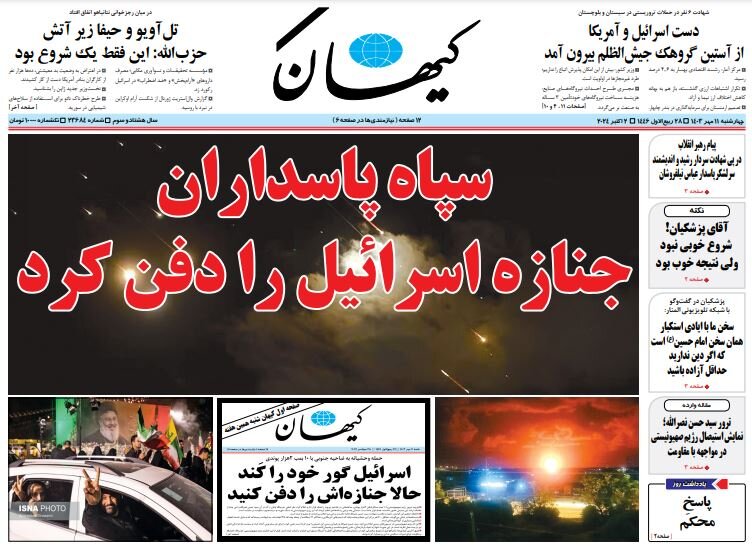
IRGC shatters Israel's absurd dignity

 TEHRAN PAPERS

TEHRAN - In a note, Keyhan addressed the IRGC's missile attack on the Zionist regime and wrote: The existence of the usurping regime was targeted on Tuesday night and the Islamic Revolution Guard Corps shattered the Zionist regime’s absurd dignity.

Rockets rained in the heart of Tel Aviv and history changed. The Islamic nation and the free people in the world were filled with joy and hope, and the terrorist government of America, which watched the humiliation of Israel, trembled in fear and caught in confusion. In this operation, some air and radar bases, conspiracy centers, and terror design centers were hit. Although this area was protected by the most advanced massive air defense systems, 90% of the missiles hit the targets successfully. Military analysts, based on published images of numerous Iranian ballistic missiles, believe that Israel's defense systems, which have been highly publicized, are powerless against the high speed and great maneuverability of Iranian missiles.

Iran: True Promise II and message of Iran's resistance against threats

In a commentary, the Iran newspaper pointed to the Iranian military’s missile strikes on Israel on Oct. 1 and the message it sent to any threat against Iran.  It said: According to the numerous pictures that were published about the IRGC's missile attack on the occupied territories and according to the reports of news sources, 90% of the missiles successfully hit the predetermined targets. It must be said that the Iron Dome was completely unsuccessful in intercepting the fired missiles. Of course, this failure was not specific to Israel's defense. The defense system of the U.S. and some European countries that are placed in the region to help the Zionist regime could not intercept the Iranian missiles. The widespread publication of dozens of Iranian missiles hitting the heart of Israel indicates heavy damage to military facilities and spy services, but the regime’s authorities began widely censor the news of Iran's attack. The spokesperson of the Israeli army asked the residents of the occupied territories not to publish or share any documents or pictures of the location of missiles and targets.

Hamshahri: A big failure for American warships

In an article, Hamshahri discussed the failure of American warships to target Iranian missiles and wrote: General Patrick Ryder, spokesman for the U.S. Department of Defense, declared that the country's naval ships deployed in the eastern Mediterranean waters fired about 10 air defense missiles to intercept and destroy the Iranian missiles that were flying towards Israel. The images of a large number of IRGC ballistic missiles hitting specific targets in the occupied territories during the "True Promise II" Operation indicate that even the advanced warships of the U.S. Navy in the regional waters failed to intercept the missiles. Live television images show the American warships, which are equipped with the most advanced weapons and interception systems, and Israel's Iron Dome were not capable of intercepting most of the IRGC's ballistic missiles that were fired at the occupied territories. The Iron Dome had been intended to create a defensive wall around Israel.

Jam-e-Jam: Pro-Western people and wrong analyses

In an analysis, Jam-e-Jam discussed Israel's psychological operations on the Iranian people and said: Netanyahu's prates, which were intended to influence public opinion in Iran, were accompanied by a wave of psychological operations these days by the pro-Western people or groups. They are humiliatingly seeking to put Iran in a difficult and vulnerable geopolitical situation in the face of enemies and demand Iran review its regional policies and negotiate with America. Compromising the country's deterrence capabilities and submitting to the enemy can be evaluated along with the psychological and propaganda operations of the pro-Western people for the military operations of the Zionists. In fact, with this mindset and analysis, they are completing the plan of the Zionists, who are trying to show themselves as a powerful and unrivaled actor. At a time when Iran and the Axis of Resistance must actively stand against the Zionist regime as the West’s mercenary in West Asia and not allow this regime to continue its crimes, these pro-Western people and groups have become defenders of peace and invite Iran to be tolerant. Therefore, they should know that their wrong analyses are against national interests.

Tuesday, August 13, 2019

அமெரிக்க ஆதரவு இல்லாவிட்டால் சவூதி அரசால் தாக்குப் பிடிக்க முடியாது

by Latheef Farook


அமெரிக்க ஆதரவு இல்லாவிட்டால் சவூதி அரசால் இரண்டு வாரங்கள் கூட தாக்குப் பிடிக்க முடியாது என்கிறார் அமெரிக்க ஜனாதிபதி
ஆனாலும் முஸ்லிம்களின் புனித ஸ்தலங்களான மக்கா மதீனா என்பனவற்றின் பாதுகாவலனாக சவூதியே உள்ளது
உலகம் முழுவதும் அலட்சியப் போக்கில் முஸ்லிம்கள்


அமெரிக்க இராணுவத்தின் ஆதரவு இன்றி சவூதி அரேபிய அரசால் இரண்டு வாரங்கள் கூட தாக்குப் பிடிக்க முடியாது என்று அமெரிக்க ஜனாதிபதி டொனால்ட் டிரம்ப் இமமாதம் மூன்றாம் திகதி இம்பெற்ற ஒரு நிகழ்வில் பேசும் போது சவூதி அரேபிய மன்னர் சல்மானை எச்சரித்துள்ளார். மிசிசிப்பி சவுதஹெவனில் இடம்பெற்ற ஒரு வைபவத்தில் பேசும் போது டிரம்ப் தனது ஆதரவாளர்களின் பலத்த கரகோஷத்துக்கு மத்தியில் இந்த எச்சரிக்கையை விடுத்துள்ளார். “நாங்கள் தான் சவூதியை பாதுகாக்கின்றோம். அவர்களை பணக்காரர்கள் என்று நீங்கள் கூறுவீர்களா? மன்னரை ஆம் மன்னர் சல்மானை நான் நேசிக்கின்றேன். நான் அவரிடம் சொன்னேன். நாங்கள் தான் உங்களை பாதுகாக்கின்றோம். நாங்கள் இல்லையென்றால் நீங்கள் இரண்டு வாரங்கள் கூட இங்கு பதவியில் இருக்க முடியாது. எங்களது இராணுவத்துக்கு நீங்கள் பணம் செலுத்த வேண்டும் என்றேன்.” இவ்வாறு டிரம்ப் கூறியுள்ளார்.
அதே தினத்தில் அமெரிக்கா 38 பில்லியன் டொலர் பெறுதியான இராணுவ உதவிகளை இஸ்ரேலுக்கு வழங்குவதற்கான உடன்படிக்கையிலும் ஒப்பமிட்டுள்ளது. 2018 முதல் 2028 வரை இந்த உடன்பாடு அமுலில் இருக்கும்.
கடந்த 14 நூற்றாண்டு வரலாற்றில் இது இஸ்லாத்துக்கும் முஸ்லிம்களுக்கும் மிகவும் வெற்கக் கேடான ஒரு தருணமாகும். முதலாவது உலக மகா யுத்தத்தின் பின் சவூதியில் பிரிட்டிஷ் காலணித்துவ சக்திகளாலும், யூத சக்திகளாலும் ஸ்தாபிக்கப்பட்ட அரசு மிகவும் கீழ்த்தரமான ஒரு நிலைக்கு சென்றுள்ள தருணம் இதுவாகும்.
ஒரு சுவிசேஷ யூதர் என்ற வகையில் ஜனாதிபதி டிரம்ப் இஸ்லாத்தினதும் முஸ்லிம்களினதும் முதல் தர எதிரியாக இருக்கின்றார். சுவிசேஷ கிறிஸ்தவ மற்றும் யூதர்களின் இஸ்லாத்துக்கு எதிரான நிகழ்ச்சி நிரலை அவர் வெளிப்படையாகவே அமுல் செய்கின்றார். அவர் ஜனாதிபதியாக பதவியேற்றதும் செய்த முதலாவது காரியங்களில் ஒன்று ஏழு முஸ்லிம் நாடுகளைச் சேர்ந்தவர்கள் அமெரிக்காவுக்குள் வர தட விதித்தமையாகும்.
சவூதி அரேபியா அமெரிக்காவில் தங்கியிருக்கும் வெற்கக் கேடான நிலை உலகம் அறிந்த ஒன்றே. டிரம்ப் பதவியேற்ற கையோடு அவரை சவூதி அரேபியாவுக்கு வரவழைத்து பெரும் மரியாதை செலுத்தபபட்டது. சவூதியின் அதி உயர் விருது அவருக்கு வழங்கப்பட்டது. ஒரு பில்லியன் டொலருக்கும் அதிகமான பெறுமதி கொண்ட தனிப்பட்ட பரிசுகள் அவருக்கு வழங்கப்பட்டன. 300 பில்லியன் டொலர் பெறுமதியான ஆயுத உடன்படிக்கை செய்து கொள்ளப்பட்டது. இஸ்லாத்தின் புனிதப் பிரதேசங்கள் மீது தொடர்ந்து தனது கடடுப்பாட்டை வைத்திருக்கவும் தனது பதவியை தொடர்ந்து தக்க வைத்துக் கொள்ளவும் சவூதி அரசால் கொடுக்கப்பட்ட இலுஞ்சம் தான் இவை.
சவூதியையும் முழு முஸ்லிம் உலகையும் நிராகரித்து விட்டு இஸ்ரேலில் உள்ள தனது நாட்டு தூதரகத்தை டிரம்ப் டெல்; அவிவ்வில் இருந்து ஜெரூஸலத்துக்கு மாற்றினார். சகல விதமான சட்டங்கள் மற்றும் தார்மிக கொள்கைகளை மீறும் வகையில் இது அமைந்திருந்தது.
டிரம்ப்பின் யூத மருமகனான ஜெராட் குருஷ்னர் இந்த விடயத்தில் முக்கிய பங்காற்றியதோடு மட்டும் அன்றி அமெரிக்க தூதரகத்தை இடம்மாற்றுவதற்காக ஜெரூஸலத்தில் இடம்பெற்ற கோலாகல வைபவத்திலும் பங்கேற்றார். இதே குருஷ்னர் சவூதி அரேபிய முடிக்குரிய இளவரசர் முஹம்மத் பின் சல்மானுக்கும் நெருங்கிய நண்பர் என்பதும் இங்கே குறிப்பிடத்தக்கது.
இதில் மிகவும் பரிதாபத்துக்குரிய விடயம் என்னவென்றால் அமெரிக்காவுடன் இவ்வளவு நெறுக்கமாக உறவாடும் இந்த சவூதி குடும்பம் தான் மக்கா மதீனா ஆகிய முஸ்லிம்களின் பிரதான வழிபாட்டு இடங்களுக்கும் பொறுப்பாளர்களாக உள்ளனர். இதுதான் இன்றைய முஸ்லிம் உலகின் மிகவும் கவலைக்குரிய நிலை. சவூதி அரேபியா என்பது எல்லாம் வல்ல இறைவனால் முஸ்லிம்களுக்காகத்  தெரிவு செய்யப்பட்ட பூமி. முதலாவது பள்ளிவாசலான கஃபாவை கட்டுவதற்கு இங்குள்ள மக்காவை தான் இறைவன் தெரிவு செய்தான். இஸ்லாத்தின் இறுதித் தூதரான முஹம்மது நபியை இங்கிருந்து தான் இறைவன் தோற்றம் பெற வைத்தான். முழு மனித குலத்துக்குமான இறுதித் தூதான இஸ்லாத்தை இங்கிருந்து தான் இறைவன் தோற்றம் பெறச் செய்தான்.
ஆனால் என்று இந்த மண்ணில் ஏகாதிபத்தியவாத சக்திகளால் சவூத் குடும்பம் ஆட்சியில் அமர்து;தப்பட்டதோ அன்றிலிருந்து தனது பிரிட்டிஷ், ஐரோப்பிய மற்றும் அமெரிக்க எஜமானர்களுக்கு சேவகம் செய்வதில் தான் இந்தக் குடும்பம் மிகவும் வெற்கக் கேடான விதத்தில் ஈடுபட்டுள்ளது. உலகம் முழுவதும் இஸ்லாத்துக்கும் முஸ்லிம்களுக்கும் எதிரான அவர்களின் சதித் திட்டங்களை அரங்கேற்றுவதில் பிரதான பங்கேற்று வருகின்றது.
1960களில் சவூதி அரேபியாவும் எகிப்திய ஜனாதிபதியாக இருந்த கமால் அப்துல் நாஸரின் படைகளும் தத்தமது தரப்பில் இருந்து போராடின. முன்னாள் யெமன் ஜனாதிபதி அலி அப்துல்லாஹ் சாலேஹ் 2017 டிசம்பர் 4ல் மரணம் அடைய இரு தினங்களுக்கு முன் ஒரு இரகசியத்தை வெளியிட்டிருந்தார். அன்றைய சவூதி மன்னர் பைஸால் முன்னாள் அமெரிக்க ஜனாதிபதி லிண்டன் பி ஜோன்ஸனிடம் கேட்டுக் கொண்டதன் பிரகாரம் தான் இஸ்ரேல் 1967 ஜுனில் ஆக்கிரமிப்பு யுத்தம் ஒன்றை தொடுத்து எகிப்தின் வசசம் இருந்து சினாய், காஸா பகுதிகளையும் சிரியாவிடம் இருந்து கோலான் குன்று மற்றும் ஜோர்தானிடம் இருந்து கிழக்கு ஜெரூஸலம் ஆகிய பகுதிகளையும் தன்வசம் ஆக்கிக் கொண்டது என்பது தான் முன்னாள் யெமன் ஜனாதிபதி வெளியிட்ட வரலாற்று உண்மை.
கமால் அப்துல் நாஸரை பழிவாங்க வேண்டும் என்ற மன்னர் பைஸாலின் தனிப்பட்ட வஞ்சம் தான் இதற்கு காரணம். 1967 ஜுனில் ஐரோப்பிய அமெரிக்க ஆதரவுடன் இஸ்ரேல் தொடுத்த யுத்தத்தின் மோசமான விளைவுகளைத் தான் இன்றும் மத்திய கிழக்கு நாடுகள் அனுபவித்துக் கொண்டிருக்கின்றன.
சவூதி அரேபிய அரசு தனது யூத கிறிஸ்தவ எஜமானர்களின் இஸ்லாத்துக்கு எதிரான நிகழ்ச்சி நிரலை இயலுமானவரைக்கும் அமுல் செய்து இஸ்லாத்துக்கு மாபெரும் சேதங்களை விளைவித்துள்ளது. அதில் பிரதானமான உதாரணம் தான் அவாகளால் அறிமுகம் செய்யப்பட்ட வஹ்ஹாபிஸம். இது இஸ்லாத்தை அழிக்கும் வகையிலான ஒரு மேலைத்தேச எண்ணக்கரு என்றும் மேதை;தேசத்தவர்களின் தேவைக்காகவே தனது முன்னோர்கள் இதை அறிமுகம் செய்து பரப்பினார்கள் என்றும் இளவரசர் சல்மான் அண்மையில் மேற்குலக ஊடகம் ஒன்றுக்கு வழங்கியிருந்த பேட்டியில் தெரிவித்திருந்தார். உலகம் முழுவதும் அமைதியாக வாழ்ந்த முஸ்லிம்கள் மத்தியில் குழப்பங்களை ஏற்படுத்தி அவர்களைக் கூறு போடுவதற்காக இந்தக் கொள்கையைப் பரப்ப சவூதி அரசு தொடர்ந்து பில்லியன் கண்க்கில் செலவிட்டு வருகின்றது. இதன் விளைவு முஸ்லிம்களை மிக மோசமான விதத்தில் பாதித்துள்ளது. அதிலிருந்து விடுபட முடியாத அளவு துன்பங்களை அவர்கள் அனுபவித்து வருகின்றார்கள்.
தங்களது வஹ்ஹாபிஸ கொள்கையை நிலைநிறுத்துவதற்காக சவூதி அரேபியா 330க்கும் மேற்பட்ட இஸ்லாமிய வரலாற்று முக்கியத்துவம் வாய்ந்த நினைவிடங்களை அழித்துள்ளது. இதில் நபிகளார் வாழ்ந்த வீடும் ஒன்றாகும். இஸ்லாத்தின் பரம எதிரிகள் கூட இவ்வாறான ஒரு காரியத்தை செய்யத் துணிவர்களா என்பது சந்தேகமே.
துளிர்விடத் தொடங்கும் இஸ்லாமிய சக்திகளை கூண்டோடு அழிப்பதில் சவூதி அரேபியா பிரதான பங்கு வகித்துள்ளது. உதாரணத்துக்கு 1979ல் ஈரானில் ஆயத்துல்லாங் கொமய்னி இஸ்லாமிய புரட்சியை கொண்டு வந்த போது அமெரிக்கா, பிரிட்டன், பிரான்ஸ், இஸ்ரேல் என்பனவற்றுடன் இணைந்து ஈரானுக்கு எதிராக அன்றைய ஈராக் ஜனாதிபதி சதாம் ஹ{ஸைனை தூண்டி விட்டது. இதன் காரணமாக எட்டு வருடங்களாக நீடித்த யுத்தத்தில் பத்து லட்சம் முஸ்லிம்கள் கொல்லப்பட்டனர். இதனால் இரு முஸ்லிம் நாடுகளுக்கும் 800 பில்லியனுக்கும் அதிகமான தொகை இழப்பும் ஏற்பட்டது.
அல்ஜீரியாவில் இஸ்லாமிய முற்போக்கு சக்திகள் அந்த நாட்டின் பாராளுமன்ற தேர்தலில் அதிகப் படியான ஆசனங்களைப் பெற்று வெற்றியீட்டிய போது அந்த நாட்டில் தலையெடுத்த இஸ்லாமிய ஜனநாயகத்தை வேறாடு சாய்க்க ஒன்றிணைந்த சக்திகளுக்கு சவூதி அரேபியா பக்க பலமாக இருந்தது. அதன் விளைவாக அங்கு இராணுவ சர்வாதிகார ஆட்சி நிலை நிறுத்தப்பட்டது. இந்த இராணுவ சர்வாதிகார ஆட்சியை முதன் முதலில் அங்கீகரித்த நாடு சவூதி அரேபியா என்பதும் இங்கே நினைவூட்டத்தக்கது.
2013 ஜுலை 3ல் எகிப்தியர்கள் தமது பெரு விருப்புக்குரிய இஸ்லாமிய சகோதரத்துவ அமைப்பின் பிரதிநிதி மொஹமட் முர்ஸியை தமது ஜனாதிபதியாகத் தெரிவு செய்த போது, எகிப்திய வரலாற்றில் 61 வருடங்களுக்குப் பின் முதற் தடவையாக நியாயமான ஒரு தேர்தல் மூலம் மக்களால் தெரிவு செய்யப்பட்ட அவரை பதவியில் இருந்து கவிழ்க்கவும் பிரதான உதவி வழங்கிய நாடு சவூதி அரேபியா தான். சவூதி, அபுதாபி, குவைத் என்பன இணைந்து இதற்கென 11 பில்லியன் டொலர்களை செலவிட்டுள்ளன. அங்கும் தமது கைக்கூலியாக அல்பத்தாஹ் அல் சிசி என்ற இராணுவ சர்வாதிகாரியை ஆட்சியில் அமர்த்தினர்.
1990ல் அமெரிக்காவும் இஸ்ரேலும் இணைந்து குவைத் சர்ச்சையை உருவாக்கின. ஆயிரக்கணக்கான ஈராக் மக்கள் கொல்லப்பட்ட இந்த யுத்தத்துக்காக சவூதி மட்டும் 56 பில்லியன் அமெரிக்க டொலர்களை செலவிட்டுள்ளது. இந்த யுத்தம் இந்தப் பிராந்தியத்தையே நாசமாக்கியது.
ஈராக், லிபியா, சோமாலியா, சிரியா போன்ற நாடுகளில் ஏற்பட்ட அரபு மக்களின் எழுச்சியை அடக்கி அழித்து துவம்சம் செய்வதில் சவூதி அரேபியா அமெரிக்க, ஐரோப்பிய மற்றும் இஸ்ரேல் யுத்த வெறியர்களுடன் தோளோடு தோள் நின்று செயற்பட்டுள்ளது.
பலஸ்தீனர்களுக்கு எதிரான இஸ்ரேலின் எல்லா குற்றச் செயல்களையும் அமெரிக்கா கண்டும் காணாமல் விட்டுள்ளது. ஒரு தசாப்தத்துக்கு முன்பே அது பலஸ்தீன மக்களை கைவிட்டு விட்டு இஸ்ரேலுடன் இரகசிய சுட்டணி அமைத்துள்ளது. உதவிகளற்ற பலஸ்தீன மக்கள் மீது தனது காட்டுமிராண்டித் தனத்தை கட்டவிழத்து விட இஸ்ரேலுக்கு அது அனுமதி அளித்துள்ளது. சவூதி அரேபியாவும் எண்ணெய் வளம் மிக்க வளைகுடா நாடுகளும் எகிப்தில் பதவி கவிழ்க்கப்பட்ட முன்னாள் ஜனாதிபதி ஹொஸ்னி முபாரக்குடன் இணைந்து பலஸ்தீன விடுதலை இயக்கத் தலைவர் யஸீர் அரபாத்துக்கு இலஞ்சம் கொடுத்து இஸ்ரேலை அங்கீகரிக்க வைத்தன. அதன் மூலம் இஸ்ரேலுக்கான நல்லெண்ணக் கதவுகளை அவர்கள் திறந்து விட்டனர். இதன் விளைவாக இன்று பலஸ்தீன அதிகார சபை பலஸ்தீனத்தின் உண்மையான சுதந்திரப் போராட்டத்தை அடக்கி ஒடுக்கி நசுக்கி கண்கானிக்கும் ஒரு அமைப்பாகவே செயற்படுகின்றது. இஸ்லாத்துக்கு எதிரான நாணயத்தின் இரு பக்கங்களாகத் தான் சவூதியும் இஸ்ரேலும் செயற்படுகின்றன.
சவூதி அரேபியா உலகின் ஏனைய பாகங்களிலும் முஸ்லிம்களை கைவிட்டு விட்ட ஒரு நாடாகத் தான் காணப்படுகின்றது. அண்மையில் றோஹிங்யா முஸ்லிம்களுக்கு எதிராக இழைக்கப்பட்ட கொடுமைகளின் போது அது நடந்து கொண்ட விதம் இதை புலப்படுத்தி நிற்கின்றது. சவூதி அரச குடும்பம் உள்நாட்டில் கொள்ளையடிக்கும் எண்ணெய் வளத்தின் மூலம் பெற்றுக் கொள்ளும் செல்வத்தை அமெரிக்காவிலும் ஐரோப்பாவிலும் முதலீடு செய்கின்றது. சவூதி அரேபியா தன்னிடம் இருந்து ஆயுதங்களை கொள்வனவு செய்ய வேண்டும் என அமெரிக்கா அச்சுறுத்துகின்றது. கடந்த பல தசாப்தங்களாக எண்ணெய் வளத்தின் மூலம் பெற்றுக் கொள்ளப்பட்ட பில்லியன் கணக்கான சொத்துக்கள் ஆயுதங்களை கொள்வனவு செய்வதில் விரயமாக்கப்பட்டுள்ளன. அமெரிக்கா, பிரிட்டன், பிரான்ஸ், ஜெர்மனி ஆகிய நாடுகளும் ஏன் ரஷ்யா கூட இந்த ஆயுத கொள்வனவால் செழிப்படைந்துள்ளது.
கடந்த ஒரு வருட காலத்தில் இந்தப் பூமியில் மிகவும் அடக்குமுறையும் கொடூரமும் நிறைந்த அரசாக மாறியுள்ள சவூதி அரேபியா இஸ்லாத்தில் இருந்தும் முஸ்லிம்களிடம் இருந்தும் மிக நீண்ட தூரம் விலகிச் சென்று விட்டது. அது இன்று அமெரிக்காவினதும் இஸ்ரேலினதும் செய்மதி நாடாக மாறிவிட்டது. முஸ்லிம்களுக்கு எதிராக அமெரிக்கா தலைமையில் உலகளாவிய மட்டத்தில் மேற்கொள்ளப்படும் தாக்குதல்களுக்கு மிகவும் விருப்பத்தோடு நிதி உதவி வழங்கும் ஒரு நாடாகவும் சவூதி அரேபியா இன்று மாறிவிட்டது.
சவூதி அரசு நிறுவப்பட்ட ஆரம்ப காலம் முதலே அரச குடும்பத்தின் எண்ணக்கருவாக அது ஒரு போதும் இஸ்லாத்தை ஏற்றுக் கொள்ளவில்லை. மாறாக இஸ்லாத்தின் தூய வடிவுக்கு களங்கம் ஏற்படுத்தி அதைப் பின்பற்றுகின்றவர்களை அடக்கி ஒடுக்கி நசுக்கி கொன்று குவித்து வருகின்றது. இஸ்லாத்துக்கு முற்றிலும் முரண்பட்ட விதத்தில் தனது சொந்த நாட்டின் செல்வத்தை சூறையாடி பத்திரமாக அதை மேலை நாட்டில் பதுக்கி வருகின்றது. இவை எல்லாவற்றுக்கும் மேலாக அவர்களின் வாழ்வுமுறை முற்றிலும் வித்தியாசமாக இஸ்லாத்துக்கு களங்கம் ஏற்படுத்தும் வகையிலேயெ அமைந்துள்ளது.
இவற்றின் நடுவே தான் சவூதி அரசு அபுதாபியில் உள்ள மற்ற சாத்தானுடன் இணைந்து யெமன் விடயத்தில் மூக்கை நுழைத்து அப்பாவி மக்களை கொன்று குவித்தும் கொடுமை படுத்தியும் வருகின்றது. இவ்விரு சாத்தான்களும் இணைந்து பழம்பெரும் பாரம்பரியம் மிக்க அந்த நாட்டை குட்டிச் சுவராக்கி விட்டனர். இந்த உலகம் இதுவரை சந்தித்திராத மனிதப் பேரவலம் அங்கு ஏற்பட்டுள்ளது. முழு நாடும் இப்போது சீரழிந்து போய் கிடக்கின்றது. உள்கட்டமைப்பு வசதிகள் முழுமையாக சிதைந்து போயுள்ளன. சிறுவர்கள், முதியவர்கள் உற்பட ஆயிரக்கணக்கான அப்பாவி மக்கள் கொன்று குவிக்கப்பட்டுள்ளனர். அன்றாடம் மரணத்தை தழுவும் சிறுவர்களின் எண்ணிக்கை அதிகரித்துள்ளது. அடிப்படைத் தேவைகளைக் கூட பூர்த்தி செய்து கொள்ள முடியாமல் அவதியுறும் மக்கள் இப்போது உணவின்றி பட்டினியால் வாடும் நிலையும் தோன்றியுள்ளது.
யுத்த வர்ணனையாளர்களின் கருத்தப் படி யெமன் யுத்தம் அமெரிக்காவாலும் இஸ்ரேலாலும் தொடுக்கப்பட்ட ஒரு யுத்தம். சவூதி அரேபிய கைக்கூலிகள் அதை அமுல் செய்து வருகின்றனர். சவூதி மற்றும் அபுதாபி மீது சர்வதேச நீதிமன்றத்தில் யுத்தக் குற்றங்கள மற்றும் இன ஒழிப்பு குற்றங்கள்; சாட்டப்பட வேண்டும் என்ற கோரிக்கை மேலோங்கத் தொடங்கியுள்ளது.
கடந்த ஆறு முதல் ஏழு தசாப்தங்கள் வரையான காலத்தில் சவூதி அரேபியா இரகசியமாகவும் பகிரங்கமாகவும் செய்த எல்லாமே மத்திய கிழக்குப் பிராந்தியத்தில் இஸ்ரேல் தனது பிடியை விரிவாக்கவும் வலுவாக்கவும் உதவி உள்ளது. இந்தப் பிராந்தியத்தில் உள்ள நாடுகளும் அரசுகளும் பலவீனமாக்கப்பட்டுள்ளன. அந்த நாடுகளின் சொந்த மக்களுக்குப் பாதகமாகவே இவை அமைந்துள்ளன.
அந்த வகையில் இன்றைய மத்திய கிழக்கை இஸ்ரேலுக்கு சாதகமான பிராந்தியமாக உருவாக்க சவூதி அரேபியா தேவையான பங்களிப்பைச் செய்துள்ளது. இப்போது தனது நாட்டை நவீன மயப்படுத்தப் போவதாக இளவரசர் சல்மான் கூறிவருகின்றார். இங்கே எல்லாவிதமான நவீன களியாட்டங்களும் அரைகுறை ஆடையில் பெண்களும் அறிமுகம் செய்யப்படவுள்ளனர். அதற்கான கடற்கரை ஹோட்டல் வசதிகள் கூட ஏற்படுத்தப்படவுள்ளன. அமெரிக்க ஐரோப்பிய மற்றும் இஸ்ரேலிய எஜமானர்களை மகிழ்வூட்டத் தான் இந்த ஏற்பாடுகளில் அவர் ஈடுபட்டுள்ளார்.
ஆனால் இந்த சல்மானும் அவரது முன்னோர்களும் தோற்றம் பெற நீண்ட காலத்துக்கு முன்பே எல்லாம் வல்ல இறைவன் தனது இறுதித் தூதரின் மூலம் இஸ்லாத்தை எமக்கு வழங்கி உள்ளான் என்பதை இவர்கள் புரிந்து கொள்ளத் தவறி விட்டனர். இந்த இஸ்லாம் என்பது உலகம் அழியும் வரைக்குமான ஒரு நவீன வாழ்வு முறை என்பதையும் அவர்கள் மறந்து விட்டனர்.
சவூதி அரேபியாவை ஒரு முஸ்லிம் நாடு என்று இனிமேல் எந்த அளவு கோளை வைத்துக் கூறலாம் என்பதே இன்றைய பிரதான கேள்வியாக உள்ளது. இந்நிலையில் அவர்கள் முஸ்லிம்களின் புனித ஆலயங்களின் பாதுகாவலர்கள் என தம்மை அழைத்துக் கொள்வதும் வெற்கக் கேடானதாகும்.
உலகம் முழுவதும் இஸ்லாத்துக்கும் முஸ்லிம்களுக்கும் எதிராக சவூதி இழைத்து வருகின்ற குற்றங்களை உலகில் உள்ள ஏனைய முஸ்லிம்கள் கண்டும் காணாமல் ஊமைகளாகவும் செவிடர்களாகவும் தொடர்ந்து இருந்து வருகின்றனர்.